

THE CHALLENGE
In this lesson you will create your very own pre production using the template provided below.
What is Film Pre- production?
Making mistakes during this phase of production can have a damaging effect on a project. When it is undertaken effectively, it can help to lay the foundation for a successful production.
During pre-production you will finalize your script, hire your cast and crew, scout locations, find equipment and build a shooting schedule. It is therefore imperative that this essential planning stage is well-managed. The pre production you will create has two parts: TREATMENT and SHOT LIST
PART 1: TREATMENT
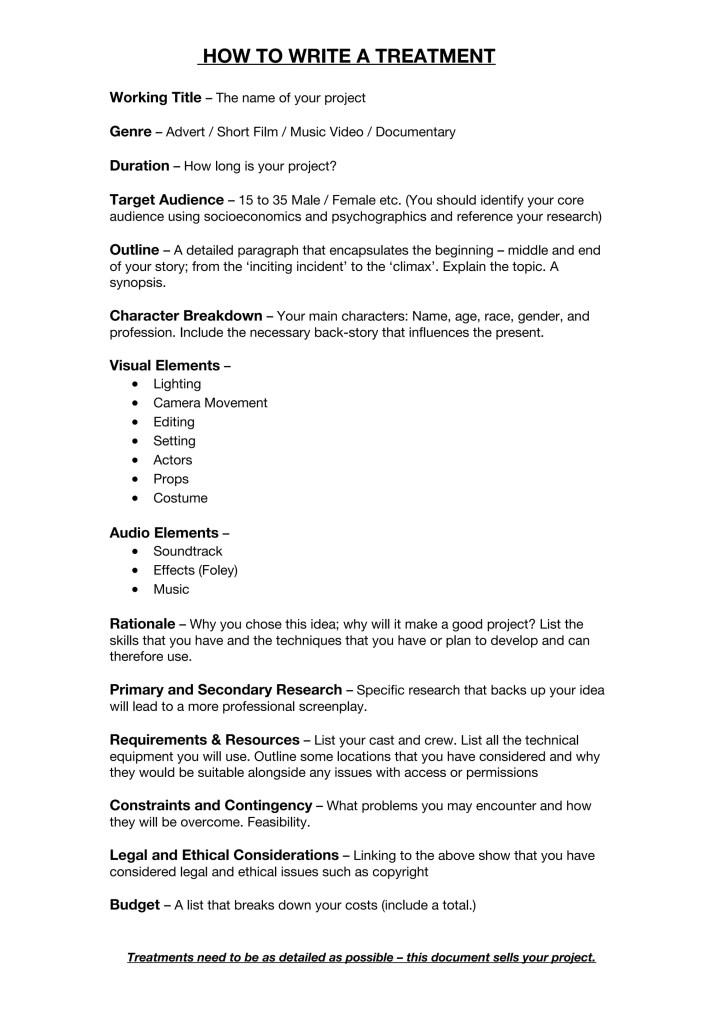
We use treatments in our video business every day to show our clients what their finished videos will eventually look like. It’s important to be careful when using treatments with clients. Like the dog example earlier, a client can read your treatment and think one thing, while you go on to produce something completely different.
Treatments are a powerful tool for conveying your thoughts to a client but don’t stop there. Develop your treatments into scripts before you shoot so there is no confusion when you’re on the set. Treatments can range in length from a few paragraphs to a few hundred pages. They tend to cover the important plot points of your story, as well as the characters and locations. Written in a narrative style, a treatment reads like a short story of your film.
For a documentary-style shoot, a treatment can help you decide the type of footage you’ll need to tell your story before you shoot. For an improv piece, your treatment might include character sketches that each actor will portray.
“Everything is pre-determined in the pre-production period. I visually design the whole thing, and I know when things will happen.”
Benjamin Franklin famously said, “If you fail to plan, you are planning to fail.” In the world of video production, no other saying is more accurate. Pre-production, or Pre-Pro, is dreaded by many; some consider it tedious, non-creative work. However, it doesn’t just save you money and time but also enhances the creative process. Let’s see how you can use pre-production to reduce stress and make your videos amazing.
PART 2: THE SHOT LIST
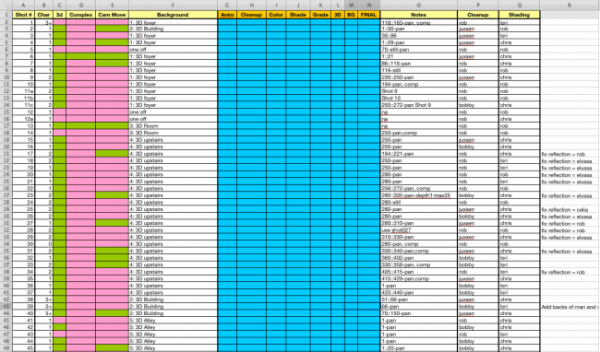
A shot list is a detailed list of every camera shot that needs to be captured in a scene of a video production. Created by the director and the cinematographer during preproduction, it outlines the precise specifics of every shot—such as the camera, shot size, and shot type—so the cinematographer and assistant director know exactly what needs to be captured to tell the story visually.
DOWNLOAD YOUR SHOT LIST TEMPLATE HERE
Movies are not often shot sequentially, as that would be inefficient and slow down the production. The shot list helps determine the most efficient shooting schedule possible. For example, if a scene requires multiple shots with both a 50mm and 85mm lens, the crew can save time and group the shots according to lens setups.
A shot list also keeps every department on track and ensures that all crew members, across every department, know which scenes are being filmed when. It determines what equipment the camera crew needs, what lighting setups need to be created, call times for the actors, and what locations, set pieces, and props need to be ready.
12 ELEMENTS OF A SHOT LIST
Every director formats their shot list slightly differently, but they all contain roughly the same information, including:
1. Shot number: the reference number assigned to each individual shot.
2. Shot description: a short description of the action and/or dialogue.
3. Shot size: how big or small the subject is in the frame.
4. Shot type: the camera angle, or how the camera frames the subject.
5. Movement: how the camera does (or doesn’t) move within the shot.
6. Equipment: the type of camera that captures the shot.
7. Lens: the camera lens used to capture the shot.
8. Frame rate: the frequency at which the frames are captured.
9. Location: where the shot is captured.
10. Actors: the actors included in the shot.
11. Sound: how the sound and/or dialogue are captured.
12. Extra notes: remaining anecdotes the director wants to convey to the crew about the shot.
RESOURCES
Steven Speilberg in Indian Jones
Pre-Production is an early stage of any project, including commercials, music videos, short films, and feature films. This crucial step defines how efficient, organized and, ultimately, how successful the production stage will be.
Let’s take a quick look at the process. In this clip, we’ll see Steven Spielberg working on Indiana Jones and the Kingdom of the Crystal Skull, including pre-visualization, costume choices, and casting Shia LaBeouf.
A typical Day in Pre Production
There are dozens of tasks to complete during Pre-Production by various crew members. One of the key roles in the process is the 1st Assistant Director. Here’s Anya Adams, 1st Assistant Director for the show “Black-ish,” walking us through a typical day on the set.
 Remtech Studio